Showing posts with label Kentucky. Show all posts

8/4/26

The City I Most Want to Visit in Each State, Part 4: Kansas to Maryland

This is the fourth post in a series. I recommend reading the firstsecond, and third posts before this one. Today I'll be picking the city in Kansas, Kentucky, Louisiana, Maine, and Maryland that I most want to visit, then listing my top 2 attractions in each location. 


---------


The City I Most Want to Visit in Each State, Part 4: Kansas to Maryland


The city I'd most like to visit in Kansas is Wichita. Quite a few celebrities grew up in Wichita, including Mars, the pygmy hippo who stole the internet's heart. Mars lives at Tanganyika Wildlife Park, which is my top attraction in the Wichita area. The next place I'd visit is the Museum of World Treasures


Paducah is the city I'd most like to visit in Kentucky. Paducah looks like such a charming town. It is one of 10 cities in the US that have been designated a UNESCO Creative City (I've been to 8 of the 10 and I very much want to finish that list.) I most want to visit the National Quilt Museum. Now that I'm a (novice) quilter, I am especially interested in spending time there. Steve and I watched Chef Sara Bradley cook during the Tournament of Champions All-Star Christmas and would really enjoy eating at Freight House, her restaurant in Paducah. 


Before visiting Natchitoches, I need to practice pronouncing it. It's NACK-uh-tish. I can pronounce it just fine until I see the word again and my brain goes to to Spanish. Anyway, Natchitoches is the city in Louisiana I would most like to visit. While there, I would go to Cane River Creole National Historic Park and the Louisiana Sports Hall of Fame and Northwest Louisiana History Museum.


The city I most want to visit in Maine is Augusta, the state capital. When there, I'll visit the Maine State Capitol, as well as the Maine State Museum. Of the 5 remaining state capitals we haven't visited, this will probably be the last, as it is the farthest from us and not close to any of our other remaining must-see destinations. Fun fact: Augusta, Maine (which is obviously part of the contiguous United States) is significantly farther from us here in California than either Juneau, Alaska or Honolulu, Hawaii. 


This may be a bit of a surprise since I'm not a beach person, but the next time I visit Maryland I would most like to go to Ocean City. My highest priority would be taking a boat tour from Ocean City to Assateague Island. The other thing I'd most like to visit is Ocean City Life-Saving Museum


---------


Are there any other must-visit places I need to know about? Please let me know in the comments!

6/22/26

State Name Art: Kentucky, Missouri, New Hampshire, South Dakota

It's Round 3 of State Name Art! This time, Kentucky, Missouri, New Hampshire, and South Dakota. As before, I love how different they each are. It's great fun figuring out how to place the letters of the state in its silhouette, then deciding what scene to add. Affiliate links below. 


State Name Art


Materials:


Steps: 


Print or trace the outline of the state onto paper. I like to use Bristol vellum when working with colored pencils. I made the outlines using graphics from PicMonkey, but you could also draw or trace your own outline. 

Use a pencil to sketch in the letters of the state. Sketch lightly so you can make adjustments if necessary. Some letters will have missing parts or distortions; that's not a problem as long as the state name is legible. Outline the letters with a Flair pen, then color in all spaces that aren't part of the name.  

Lightly sketch a scene across the white space of the letters, choosing an image that represents the state. When you are happy with what you've sketched, fill it in with colored pencils. I drew a horse in a pasture for Kentucky...


... Gateway Arch for Missouri...


... sunset over the mountains for New Hampshire...


... and a buffalo grazing for South Dakota. 


Cut out the state and glue it to colored construction paper. 

I'm continuing to have a lot of fun with these. This makes 12, which is a far cry from 50. I'll keep taking them four at a time until it's not fun anymore.

6/3/26

Gold, Silver, and Coal Mine Cart Craft

Today I have a 3-in-1 craft for you. Follow the simple steps to make a traditional mining cart out of paper, then "fill" it with gold, silver, or coal. It's a great project to accompany a study of the role that gold, silver, and/or coal mining played in your state's history. Affiliate links below. 


-------


The most famous gold rush in history took place in my home state of California. Following the discovery of gold at Sutter's Mill in 1848, approximately 300,000 "forty-niners" poured into California the following year, hoping to strike it rich. California isn't the only state with a gold rush. The Klondike Gold Rush (1896-1899) is almost as famous. Approximately 100,000 prospectors hiked through Alaska on their way to the gold fields. Other states with significant gold rushes include North Carolina (1802), Georgia (1829), Colorado (1859), and South Dakota (1874). 


What do Nevada, Colorado, Idaho, Montana, Utah, and New Mexico have in common? Each of these states had a silver boom in the late 1800's. Nevada, nicknamed the Silver State, had the first silver rush in the US in 1859, following the discovery of the Comstock Lode in Virginia City. Nevada remains a major silver producer today, along with Alaska, Idaho, and Utah. 


Pennsylvania is the birthplace of the coal industry in the US. It had the largest anthracite deposits in the world during the 19th and early 20th centuries. West Virginia has been one of the top producers of the softer bituminous coal. Kentucky, Illinois, Wyoming, and Montana all have played a significant role in the production of coal. 


Gold, Silver, or Coal Mining Cart


Materials: 


Steps:


Cut a 6" x 3" rectangle of medium brown paper and set it aside. Then cut seven strips of medium brown paper, each approximately 6" x 0.5". Ink the edges of the strips, then glue them to the rectangle. 


Cut 1/4" strips of darker brown to make the metal trim that secures the boards. Glue the pieces in place (2 horizontal and 3 vertical) as shown below. Then trim the edges to give the mine cart its trapezoidal shape. Punch a pair of circles from the dark brown. 


Use a colored pencil to add grain, knots, and shading to the wood. Add dots to mimic rivets on the metal. Draw spokes on the wheels. 


Glue the wheels in place and you have your mine cart. 


Cut a piece of glitter paper (gold, silver, or black) and glue it behind the mine cart. 


I wish I'd thought of this idea a couple of decades ago so I could have made these with my 4th and 5th graders. I had a space above my chalkboards that would have been perfect for displaying a long line of mine carts holding gold.

1/29/26

The Best and the Worst of the 50 State Seals, Part 2

This is the second post (of five) rating the designs of each of the 50 state seals. I suggest starting with the first post, which gives the background and explains the criteria I'm using for grading. 


---------


Rating the State Seals: Hawaii through Maryland


Hawaii's state seal was adopted at statehood in 1959. It features King Hamehameha, the goddess Liberty holding the Hawaiian flag, a rising sun, a phoenix, 8 taro leaves representing the 8 main islands, banana leaves, ferns, a kapu stick, and more. The state motto, written in Hawaiian, translates to “The life of the land is perpetuated in righteousness.” There is no question that this seal represents the state well with all those elements, but the resulting design is very crowded. It would be a much better design with just half the elements. 

Design 2.5, Representation 5 = 7.5


The state seal of Idaho was updated in 1957 to highlight Idaho’s main industries (mining, agriculture, and forestry) and the state’s natural beauty. The woman symbolizes justice and the virgin land of Idaho and the man is a miner; together, they protect the items shown in the shield. Idaho's state flower (syringa) is represented, as is the state motto. It represents the state well and is nicely balanced, if a bit crowded. I'd change the colors to be more harmonious. (Fun fact: Idaho has the only state seal designed by a woman.)

Design 3, Representation 5 = 8


The state seal of Illinois was most recently updated in 1869, replacing the original seal that was nearly identical to the seal of the United States. The design features a bald eagle in profile, on a rock, holding a shield, with a banner in its beak proclaiming the state motto (State Sovereignty, National Union) reading from bottom to top, with a twist in the banner that makes word Sovereignty upside-down. There is an oddly-shaped sunrise over water. I am not a fan of this design. While it no longer looks like the seal of the US, it still has many of the same elements, including a shield with 13 stars and stripes. Illinois is the 21st state, not one of the original 13 Colonies. The statehood date (1818) appears twice, which is unnecessary. There is no reason for 1868, the year the seal was redesigned (before being adopted in 1869), to appear on the seal. I hate the spacing / kerning of the text. 

Design 1.5, Representation 1 = 2.5


The most recent version of the state seal of Indiana is from 1963. It features a forest with a man felling a sycamore tree, a bison running away, and the sun setting behind some hills. The designs in blue on either side of the date are the leaves of the tulip tree (the state tree), with dots and diamonds in between them for no apparent reason. (Am I the only one who sees a chicken?) There are 14 rays on the sun (Indiana is the 19th state, so this is not symbolic). I don't hate the seal, but I don't like it either. Without the text and the date, I would have never known this was supposed to be Indiana. Many states have (or had) bison, forests, and hills. 

Design 2.5, Representation 1.5 = 4


The state seal of Iowa was created in 1847, a year after statehood. It includes a soldier in a wheat field (the predominant crop of 1840's Iowa vs. the corn and soybeans that dominate now). He is holding a gun and the US flag topped with a liberty cap. He is surrounded by symbols of farming, mining, and transportation. The ship is the Steamboat Iowa, famous for holding the speed record on the Mississippi from 1843 to 1849. An eagle at the top of the seal holds the state motto. (Fun fact: The wording describing the seal is controversial, but it remains unchanged as of January 2026.) The design of this seal isn't terrible and it represents 1840's Iowa decently. The scale of the items is weird, unless that's a child's dollhouse with a working chimney. The motto is hard to read, since you have to start with the bottom left, move above it, then across, then down. I'd like this seal more without the soldier, US flag, and (especially) the gun.

Design 2.5, Representation 3 = 5.5 


The state seal of Kansas, adopted in 1861, focuses on the history of the state. It includes a sun rising in the east, a river and steamboat (representing commerce), a man plowing (representing agriculture), a settler's cabin plus covered wagons heading west (representing pioneer life and Westward Expansion), indigenous people on horseback hunting bison, the state motto ("To the stars through difficulties") and 34 stars representing Kansas' admission as the 34th state. This is a well-balanced design that represents the state very well. I appreciate that the original inhabitants are acknowledged (and not in an adversarial way). 

Design 4, Representation 4.5 = 8.5


The state seal of Kentucky was originally designed in 1792, then simplified 170 years later to portray "a pioneer meeting a gentleman in a swallowtail coat." Many believe the man in buckskin is Daniel Boone (a pioneer in the exploration of Kentucky) and the man in the suit is Henry Clay (Kentucky senator and eventual Secretary of State), but officially they are not specific people and instead represent all frontiersmen and statesmen. The seal also includes the state motto and goldenrod, the state flower. This seal could be so much better, but at least it's not too busy. 

Design 1.5, Representation 2.5 = 4


The state seal of Louisiana was most recently revised in 2006. The seal is very distinctive, featuring a pelican in her piety, traditionally a Christian symbol of self-sacrifice. The state motto (Union, Justice and Confidence) appears prominently. While the pelican might have first been chosen to honor the state's Catholic heritage during a time of anti-Catholicism elsewhere, I'd rather see the Pelican State design a more secular seal with a pelican that isn't actively bleeding. It's not the Self-Sacrifice State, after all. 

Design: 2, Representation 2 = 4


The state seal of Maine was adopted in 1820. In the center is a shield featuring a moose, resting in front of a pine tree, between the water and the woods. Two men (a farmer with a scythe and a sailor with an anchor) stand on top of a banner, on either side of the shield. The top of the seal has the state motto ("I direct") and the North Star. This design isn't particularly attractive, but it could be dramatically improved with just a few changes. I would expand the scene in the shield to fill the entire background of the seal, then move DIRIGO to where MAINE is located and write STATE OF MAINE in large letters across the top. Right now, the red DIRIGO banner looks like a brand name on a package of pasta sauce. 

Design 2, Representation 4 = 6


The state seal of Maryland is two-sided, but since the front was never cut and thus not used as a seal, I'll be focusing on the reverse. It was updated in 1959. It features the Calvert coat of arms being held by a farmer (holding a spade) and a fisherman (holding a fish). Behind them is ermine fur and at the top is a crest with two pennants. Below is the state motto. The literal translation is "Deeds are males, words are females" but in 2017 they changed the official translation to "Strong deeds, gentle words." The poorly-spaced text around the seal translates to "With favor wilt thou compass us as with a shield" and 1632 is the date Maryland was established. This design represents the origin of the (province then colony then) state well enough, but I think there is too much emphasis given to the founder. I'd like to see more of the natural resources, industry, or something else. 

Design 3, Representation 3 = 6


---------


So far, we have Arizona (10), California (9.5), Kansas (8.5), Alaska (8), Idaho (8), Delaware (7.5), Hawaii (7.5), Colorado (7), Florida (6.5), Maine (6), Maryland (6), Iowa (5.5), Kentucky (4), Louisiana (4), Indiana (4), Alabama (3), Georgia (3), Illinois (2.5), Arkansas (1.5), and Connecticut (1). Let me know in the comments if you agree with my rankings. Tomorrow I'll look at the next ten seals. 

1/16/26

Standing Horse Craft for Kids

Did you know that there are 17 states which have named a horse as one of their state symbols? Thirteen states have an official state horse, including: Alabama (Racking Horse); Florida (Florida Cracker Horse); Idaho (Appaloosa); Kentucky (Thoroughbred); Maryland (Thoroughbred): Massachusetts (Morgan); Mississippi (American Quarter Horse); Missouri (Missouri Fox Trotter); North Carolina (Colonial Spanish Mustang), Oklahoma (American Quarter Horse); South Carolina (Carolina Marshy Tacky); Tennessee (Tennessee Walking Horse); and Texas (American Quarter Horse). Two more states have named a horse as their state animal, including: New Jersey (Horse) and Vermont (Morgan). Virginia has a state pony (Chincoteague). North Dakota has an honorary equine (Nokota). With so many state honoring this animal, it was the obvious choice for my next craft. 

In order to represent multiple breeds of horses for this blog post, I made my craft two sided. You can opt to make yours the same on both sides (like a normal horse) or different (like mine). Affiliate links below. 


Standing Horse Craft


Materials: 


Steps: 


Create a pattern for your horse. You can draw a horse or find a photograph you like and cut that out. Trace the pattern twice onto chipboard. Cut out both horses. Paint each horse with a base coat of paint. (Remember, I made my horse two different colors intentionally.) Let the paint dry. 


Finish painting the horses. For my brown horse, that meant giving it a second coat and adding dark brown for the hooves. For the spotted horse, I added the spots and the striped hooves that are characteristic of an Appaloosa. 

Wrap embroidery floss around the four fingers of your non-dominant hand, going around 12 times. 


Use the scissors to snip below your pinkie to make 24 strands that form a tail. Glue the hair in place on ONE of the two horse pieces. 

Wrap embroidery floss around two fingers, going around 12 times. Snip that to make the mane. You'll be gluing it along the back, then folding it over toward the front. Start by putting a line of glue on the back of the horse, then lay the mane in place. Repeat as necessary until the mane and forelock are as full as you want. Let the glue dry. At this point, the mane will be sticking up. To make it lay flat, spread glue along the front side and press the mane into it. Trim as needed. Repeat the process for the second side of the horse, as desired.  


To make the horse stand, spread glue on the back side of the body, neck, and head of one horse. Do not put glue on the legs. Press the two sides together, then secure them with binder clips. (I took the picture before adding the rest of the clips. You'll want one by the throat and one over the tail. 


When the glue is dry, remove the clips and you'll have a horse that stands. I opted not to add facial features, but that's a personal choice. 

9/12/25

12 of the Most Memorable Local and Regional Desserts Across the US

I'm a firm believer in trying the local specialties whenever we travel. And of course that includes dessert! Below are 12 of the most memorable local and regional desserts we've tried during our travels across the US. Most of these are not available anywhere else (except by mail order) and some of these are so good that it's well-worth a visit just to try them! 


Maple Creemee - Vermont; Kringle - Wisconsin; Smith Island Cake - Maryland  
Huckleberry Cheesecake - Montana; Gooey Butter Cake - Missouri; Derby Pie - Kentucky
Hoosier Pie - Indiana; Bourbon Balls - Kentucky; Chicago-Style Popcorn - Illinois
Biscochitos - New Mexico; Buffalo Berry Candy - North Dakota; Water Ice - Pennsylvania


I would happily eat any of those right now, but the two that I think about the most are Derby Pie and the maple creemee. They're soooo good! Are there any other local or regional desserts from where you live or that you've discovered during your travels? Let me know in the comments!

4/25/25

The Best Tour in Every State, Part 2

This is the second part in my series about the best tour I've taken in every state. I recommend starting with the first post, which provides important background information, including my definition of a tour. 


-------


Hawaii


The best tour I've taken in Hawaii was The Best of Hilo. Highlights of the tour included the Tropical Botanical Garden, Rainbow Falls, Mauna Loa Macadamia Nut factory, Volcanoes National Park, and walking through a lava tube. It was fantastic.


Idaho


I've been to Idaho seven times in the last ten years to visit my family, so you'd think I would have taken at least one tour. Nope. While we've done a lot of fun activities in Idaho, none of them were tours. The closest to a tour would be the World Center for Birds of Prey, where we watched docents and staff give presentations. 


Illinois


The best tour I've taken in Illinois was by the Chicago Trolley and Double Decker Co. We had a fantastic guide who took us to all the best places in Chicago and taught us so much about the history, geography, and culture of the city. 


Indiana


The best tour we took in Indiana was Indy Fun Trolley Tours. Our guide went above and beyond, teaching us everything there is to know about Indianapolis - not just the history and points of interest, but restaurant recommendations, great stores, and even where to get the best donuts in each side of town. 


Iowa


The best tour I've taken in Iowa was a guided tour of the State Capitol. By being with a guide, we were able to go places that self-guided visitors can't go, including up a circular staircase to the dome. We had a great guide who told us so much about both the building itself and those who have worked there over the years. 


Kansas


The best tour I've taken in Kansas was the Dome Tour of the Capitol building in Topeka. Not only was it interesting and informative, but it was quite a workout!


Kentucky


It was really, really hard to pick a favorite tour in Kentucky, as we have taken quite a few excellent ones. Ultimately, I had to pick the guided tour of Churchill Downs as the best. We learned all about the history of the track, the Derby race itself, and the various winners. The highlight was going onto the track and standing in the winner's circle.  


Louisiana


Picking the best tour in Louisiana was very difficult. We had several outstanding tours, but I think I have to pick the guided tour at Mardi Gras World as my favorite. I loved the behind-the-scenes look at everything that goes into making all the incredible Mardi Gras floats, and particularly enjoyed seeing the artists at work. Trying authentic King Cake for the first time made the tour even more fun and memorable.


Maine


The best tour I've taken in Maine was a guided walk at Acadia National Park and Cadillac Mountain. It was absolutely beautiful and our guide was excellent. It was exciting seeing a variety of animals and experiencing multiple biomes during a relatively short walk at Acadia. The views from Cadillac Mountain were stunning. 


Maryland


The best tour we took in Maryland was the guided walking tour at the United States Naval Academy. We learned so much about the Academy and what student life is like. So interesting and a really different college experience than the one I had!


I'll be back on Monday with the best tours I've taken in the next ten states. 

11/12/24

50 State Quarters: Coloring Pages Using Derwent Inktense Pencils

I've completed four more of the 50 State Quarter coloring pages: Arizona, Illinois, Kentucky, and Louisiana. This time, I colored them with Derwent Inktense Pencils and a blender pen. Affiliate links here and below. 


I'm relatively new to Inktense Pencils and there is definitely a learning curve. I found the Derwent Intense Pencils Beginners Guide by My Colourful Country Life very helpful. Once I learned the basics, it was so much fun to use the Inktense pencils on the different coloring pages. I'm eager to get them out again and practice some more.

This set of four brings me to 30/50 completed coloring pages. These are the other art materials I've used so far:

On to the next set of coloring pages!

10/2/24

Blackberry Ink with a Feather Quill Pen

Have you ever made your own ink? There are many natural materials that can be boiled or juiced to make inks and dyes in a variety of different colors. Blackberries (the state fruit of both Alabama and Kentucky) produce a beautiful reddish-purple juice that kids can use directly on paper as ink. For extra fun, use a feather as a quill pen! Affiliate links below.     


Blackberry Ink with a Feather Quill


Materials: 


Steps: 


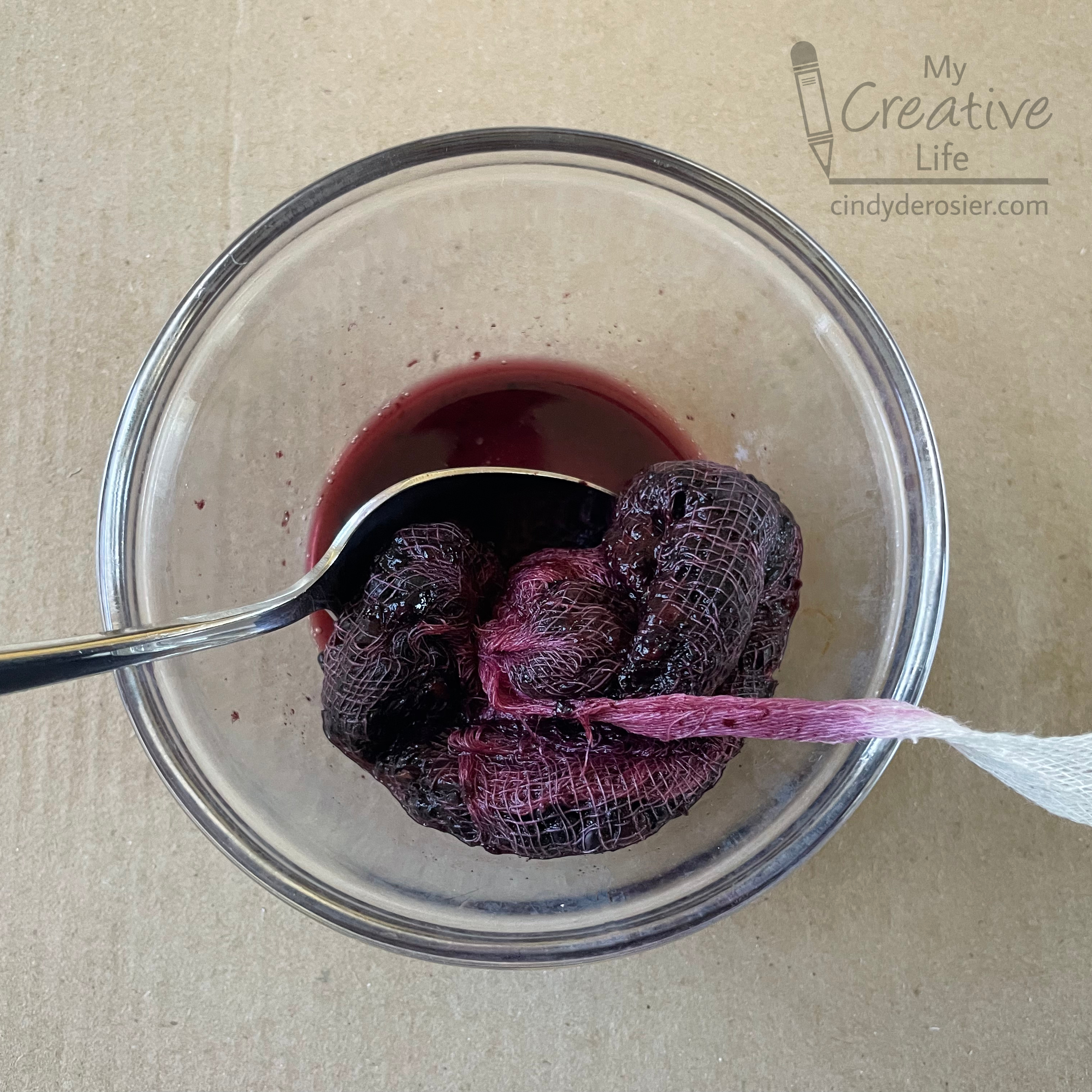
Wrap several very ripe blackberries in cheesecloth. Tie an extra strip of cheesecloth around the bundle to use as a handle (unless you don't mind purple fingers!). Put the bundle in a glass bowl, then press the blackberries with the back of a spoon. Continue to press until you've extracted as much of the juice as you can.


Discard the bundle of blackberries. Place a coffee filter over a second container (hold it in place with a rubber band, if necessary) and slowly pour the juice over the coffee filter. It will catch any bits that made their way through the cheesecloth. Now you can use your ink for drawing, coloring, and writing.

A note about feathers: I used what I had on hand, which were dyed. For a project about natural dyes, I'd use natural feathers, which is what you'll find above in the materials list. I used my feather straight out of the package; occasionally, you'll need to prepare the feather by pulling off any bits near the writing end and possibly trimming the very end to make it smooth. 


If you let the paper dry between layers (naturally or with a heat gun), you can add more ink on top to get darker colors. I did this several times to get my final blackberry drawing, although I didn't trace over my writing. 


Obviously, it is imperative to have extra blackberries on hand for snacking! So good. 


When you are done with the project, discard your ink. Because it wasn't boiled and there are no preservatives, it's not meant to last long-term. If you would like to make ink that will last, I recommend this excellent tutorial by Dana Driscoll. Enjoy!