Showing posts with label My Teaching Days. Show all posts

5/27/26

Glen Cove Elementary, 20 Years Later

From 1995 to 2006, I taught fourth and fifth grade at Glen Cove Elementary School. My last day as a teacher was May 17, 2006, which was a Wednesday. I left at lunchtime. There was still a month left before the school year ended. I loved my job and I had a great class that year, but I had a very good reason for leaving midday, midweek, a month early: I was nine months pregnant. My doctor wanted me resting as much as possible. I'd been leaving school at lunchtime for the past month. With state testing finished that morning, I would be home full-time until the baby was born (exactly three weeks later, as it turned out). Fortunately, I'd used so little sick leave during my 11 years of teaching that I had enough time to cover a month of afternoons off in addition to the month of full days I was taking off, with plenty left over. 

I visited my former coworkers at Glen Cove fairly often for the first few years after I stopped teaching, until eventually almost everyone I knew there had retired. The last time I was at Glen Cove was in May 2016. I attended the retirement party of Greg Allison, the principal I'd had all 11 years I taught. Spending time at Glen Cove, with so many of my former coworkers, was like coming home. 

Somehow, ten years have passed since then, meaning it has now been twenty years since I ended my teaching career. I decided that I would mark 20 years out of the classroom by visiting the school. By happy coincidence, the current principal at Glen Cove, Kensaburo Daniels, is a leader in our Scout troop, so it was easy to make the arrangements. Since May 17 fell on a Sunday, I visited Glen Cove on Monday, May 18. 


My first surprise was immediate. There is a fence around the school! This used to be completely open. It looks so different with the fence there. 


Time to check in at the office!


The building is the same, but so many things are different. It was surreal. Back in the day, the teachers had a dedicated work room across from the main office. Now it is office space and the copier and laminator are in the staff room. Areas that were used for storage when I was there are now offices and spaces we used for storage are used for small group work with students. 

The cafeteria hasn't changed much. 


The trophy case now has photos from the construction of the school, which began in 1988. 


Glen Cove was named a California Distinguished School in 2000. I was part of the group that worked on the successful application.  


This is the school library. There was a class in there when I visited, so I photographed the only area without kids. The room has more tables in it than when I was a teacher, but otherwise is pretty similar. 


B-Pod was my building for all 11 years that I taught. It has six classrooms, B1-B6. I started in B5 when we were a four-track year-round school. Every three months when we went off track, the students and I packed up every single item in our classroom and stored it all in the middle of the pod. After a month off, we came back into the classroom that had just been vacated by another class. It was a weird schedule, but I loved it. (The schedule, not the packing and moving. That part was terrible.) The school year started the first week of August in B5, then we had the entire month of September off. We moved into B6 for October, November, and December, then we had two weeks off for the holidays, plus the entire month of January. We came back to a third classroom, B4, for February, March, and April, then had all of May off. We were back in B5 for June and most of July, then the school year ended. There was a week off before the new school year started. 


When Glen Cove went to a single-track modified year-round schedule, whatever classroom each teacher was currently in became their permanent home. Mine was B4. 


Now B4 is used as an art room. 


So many things are different, most having to do with technology. The first thing I noticed is that my beloved chalkboards are missing! So are my pull-down maps and the screen I used with an overhead projector. I had one single computer in my classroom that I used for writing worksheets and parent letters and the kids used for Accelerated Reader; we had no Internet access. When I visited, there were Chromebooks out on most of the desks, as the art room was temporarily being used for state testing. 


The Dutch doors that we had (and weren't allowed to use for fear someone would lose a finger) have been replaced with normal doors. There are proper screens over the porthole windows. Most teachers left their windows uncovered back in the day, but since B4 faced the playground, I covered mine with curtains so that the primary kids didn't use their entire recess staring at us like zoo animals. 


That area on the left used to be grass. 


The playgrounds are similar to how they used to be, other than the now-dead grass. You'll have to take my word for it; there were kids playing on all the structures and at the basketball courts, so I didn't take pictures of any of that. I was pleasantly surprised to see that the painted map of the US was still visible on the concrete. I was there when it was painted. My students and I used it all the time for geography games and general fun. 

See those painted storage units? They were painted during Glen Cove's 20th birthday party in 2009. 


I wasn't teaching anymore, but we attended the party and had a great time. In fact, the smallest child on those storage units is Trevor! Check out these pictures I found. Trevor was 3.


Back to present-day. There is a fence separating the playground from the field. We used that field for PE, Presidential Physical Fitness testing, field days, outdoor art activities, and so much more. 


Another major change at Glen Cove: the people. There is exactly one person left from 20 years ago, Mrs. Ochoa. It was great to see her. By the way, I wore my 1995 Glen Cove Hawks t-shirt for my visit. I got a lot of comments about it. 


In some ways, my teaching career feels like it ended yesterday and in other ways, it feels like a lifetime ago. 


I had such a such a great visit. It was the perfect way to mark the milestone of 20 years out of the classroom. Huge thanks to Mr. Daniels for his time and to everyone at Glen Cove for their hospitality.

2/14/24

Lucky Numbers Math Game for Kids (Decimal Place Value + Probability)

Back in my teaching days, I loved playing games with my students. It's such a fun way to introduce or reinforce a concept. I particularly enjoyed math games, as did the kids. One of our favorites was one I called Lucky Numbers. 

The beauty of Lucky Numbers is that you can play with any size group - we regularly played as a whole classroom. A single round is really short, so you can squeeze in a game in the awkward three minutes before dismissal, or during a 10-minute rainy day recess. All you need is a single 10-sided die (affiliate link here and below). 


Before I get to the game, I have to talk about kids and dice. Kids LOVE dice. Every single student I ever had liked playing with ordinary 6-sided dice. When I pulled out the 10-sided dice or the fraction dice, they'd go nuts. Kids who weren't ordinarily engaged during math time were practically falling out of their seats waiting for me to pass out the special dice and teach them the game we'd be playing. I never thought to do it, but honestly, I should have bought a bunch of dice and used them as rewards. Or a fundraiser! If I'd thought to have my students sell sparkly 10-sided dice back in the day, we could have paid for all of our field trips. These colorful 10-sided dice cost less than 13 cents a piece. I guarantee you we could have easily sold them for a dollar a piece. And if we'd done a blind purchase, where you pay your dollar to reach into the bag and pick a random color, we could have sold even more as people tried to get their favorite colors. 

Anyway, on to the game. The objective of Lucky Numbers is for students to learn decimal place value to the hundred thousandths, to understand what each position means, and to be able to accurately read a number with a decimal place. To play, each student needs a piece of paper and something to write with.  

On the chalkboard, draw a number of lines representing how many digits are in the target number. Around 5 is best. Have the kids copy this onto their paper. As an example, let's start with a number with three places to the left of the decimal points (hundreds) and two to the right of the decimal (hundredths). 


Roll the die and announce the number. (These huge dice are a hit in the classroom.) All players need to write that digit into one of the empty positions, trying to make the largest number possible. So if the digit is 9, the smartest location to put it is in the hundreds place. If the digit is 0, you'd put it in the hundredths place. Those are obvious - the other digits take some logic and some luck!

Here's a game in progress. Our pretend classroom is on our fourth round of the day. The student did great on their first round. 96.837 is a high number, but anyone who put the 9 in the tens place and the 8 in the ones place will beat it. The second round did not go well for this student, who was betting on a high digit coming up for the hundreds place and ended up with a 3. (Once a digit is written, you can't move it). In the third round, the student got the fourth highest possible number (9.820 would win, 9.802 and 8.920 would beat it). 


In the current (fourth) round, our pretend student put the four in the ones place. This is a good move. The next roll was a 5, which they put in the tens place. Now there's a three. Where should it go? Do you put it in the tenths place and hope that the next two rolls are higher than 3? Statistically speaking, yes, that's what you should do.

After the final roll, there are always immediate groans and cheers. After writing in my final digit, I would model how to read my number, then call on students to read their numbers. I emphasized using the place value chart to help them say the number correctly, which included saying "and" for the decimal point instead of "point." So 8.902 should be "8 and 902 thousandths" not "8 point 902." 


Anyone who scored higher than me AND could correctly pronounce their number (with help, if necessary) would earn a point. If I got the highest possible number, I earned the point. The points didn't really matter, of course, but the kids always got a kick out of beating me. And I got a kick out of seeing them learning while having so much fun. 

11/30/22

Fun with Math Puns: Making Winter Symme-trees

My favorite puns are the really intellectual ones, where you have to have specific, often esoteric knowledge to get the joke. I'm sure that I miss many of them completely as they go over my head, but that only makes the ones I do get all the more satisfying. It's like a little reward knowing that you're educated enough (in at least one specific area) to understand an intellectual pun. 

The first time I remember really appreciating a pun was around 1st or 2nd grade, when I discovered The King Who Rained (affiliate link here and below). I laughed out loud in our silent school library, checked out the book, and laughed about it every time I thought about it. I checked that book out at least a dozen times over the rest of my elementary school career. I was also a huge fan of Amelia Bedelia. We had a Japanese exchange student and her teacher stay with us when I was 8 and they LOVED those books. Getting the joke in a language you're learning must be even more satisfying than in your native language. 

Back in my teaching days, my students loved discovering a punny book in our class library that they hadn't previously understood. Like when we would first encounter circumference in the math book... one year, a student yelled, "Hey!" and ran giggling to the class library to pull out these books, super pleased with himself to finally get the joke. That totally made my day. It's an amazing feeling to see kids not only learning, but making a strong enough connection with material to understand a pun. 

I was thinking of those kids when I made these Symme-trees. Naturally, they go perfectly with a math lesson about symmetry. Wouldn't a whole bulletin board of them look great?


Winter Symme-trees


Materials:


Steps:


Set aside one sheet of light blue cardstock. Cut the other sheet into six pieces, each approximately 4" x 6". Use the scoring board to make a fold line down the center of each. Add green paint to the right-hand side of each piece, vaguely forming the shape of half a tree. Start with a conversative amount of paint. You can add more, but can't remove it. 


Fold the paper along the scored line, pressing the paint onto the other side. Open up the paper; if you're happy with the tree, set it aside to dry and move on to the next one. If there wasn't enough paint, just add more on the right side and press again. 

Let all six trees dry completely. When they are dry, add horizontal swaths of white paint to mimic snow. Fold and press. Again, you can add more paint in it doesn't transfer well. 


When the white paint is dry, add brown for the trunk. Let all the paint dry completely, then fold the trees the opposite direction, so that the paint is facing out. Carefully cut around each tree. 

Cut the white cardstock into snowy hills. Ink the edges with pale grey ink, then glue them to the background paper. You can glue your trees directly to the background paper too, but I used foam tape to pop them up and add extra dimension. It's hard to tell in the scanned image, but it makes a big difference in person. Finally, decorate with snowflakes. Adding a "SYMME-TREES" title is optional. 


If I were making these in the classroom, I'd follow up with challenging the students to think of tree puns to work into a story or other piece of creative writing. I would love to cedar clever ideas... fir sure!

11/12/21

How to Draw Pumpkin Pie

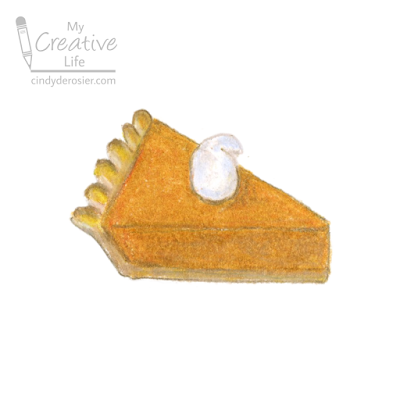
I'm a huge fan of integrated curriculum. Art pairs well with literally every other subject area, and I'm particularly fond of using art projects to reinforce math vocabulary. Many teachers draw pie as a way to teach students about pi, but there's no reason to stop there. Back in my teaching days, I enjoyed giving my students drawing instructions using geometry terms they'd recently learned. This slice of pumpkin pie provides an excellent example of a scalene triangle. 


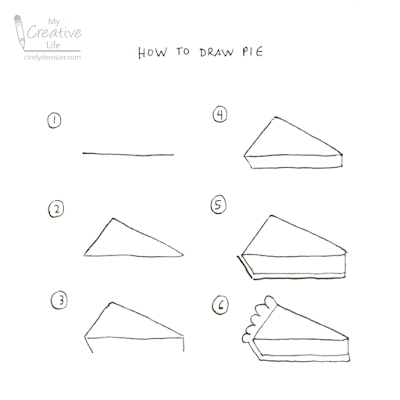
How to Draw Pumpkin Pie


  1. Draw a horizontal line segment in the center of the paper. 
  2. Use that line segment as the base of a scalene triangle. The base should be the longest side of the triangle. This is the top of your pie. 
  3. Add two short line segments onto the base of the triangle. The one on the left should angle down and to the right. The one on the right should be vertical. 
  4. Draw a horizontal line connecting the two new line segments. It should be parallel to the original line segment. Now you've finished the pie filling. 
  5. To draw the bottom of the crust, find the obtuse angle you made in the previous step. Draw the same angle slightly below the other one, extending the line segments the same length as the others. 
  6. Finish the crust by drawing a series of scallops along the shortest side of the scalene triangle.  


This drawing gave me an idea I'm excited to test. If it works, I'll share the results with you next week. If it doesn't, forget I said anything. 


10/1/21

Crayons: The Problem with Being the Best

As I was hunting for any stray colored pencils that might be hiding throughout the house, I decided to reorganize our huge collection of crayons. ("Because why not start a big, messy project when you're literally in the middle of doing something else!" I always say.) 


I'm not kidding when I say we have a huge collection of crayons. Back in 1995 when I started teaching, I had a small collection of crayons - a few small sets, plus the big set with the built-in sharpener. I kept one set at home, but dumped the rest into a crayon bin for the classroom. The school issued every student a box of crayons each year. Most kids kept their crayons in good shape all year long, but for the 3 or 4 kids who lost them or otherwise needed more, they could take what they needed from the bin. At the end of the year, I told them they could take home their crayons or dump them into my bin. Most dumped them into the bin, knowing they'd get fresh crayons when the new school year started.... one week later. (For my first few years as a teacher, our school was four-track year-round. My section started in August and ended in July, with September, January, and May off. When school ended in July, we had one week off before the new school year started in August. Our school eventually switched to a modified traditional schedule, but almost everyone still dumped their old crayons in the bin.)

We did a lot of crayon art in the classroom, but still the collection grew. There were kids who dumped crayons they didn't use at home into the bin. Eventually, one large bin became two. 

When Trevor was born and I moved out of my classroom, I left one bin behind and took one home. Over the years, more crayons have come into the house as gifts, manufacturer samples, party favors, and with kids' menus. All that to say, we have a huge collection of crayons. 

Now, a question. At the top of this post is a photo of eleven blue crayons. What brands do you remember seeing? 


-----


-----


-----


-----


Chances are, you remember seeing Crayola (or guessed correctly that it was among the eleven). In fact, two of the eleven crayons are Crayola. They're from different eras, so the logos differ a bit. You might also remember seeing Prang or Cra-Z-Art, as there is one of each. But I guarantee that's all you saw. Why? Go back and look at the photo. 

The remaining seven crayons are not branded. Instead, they have the word Crayon(s) in fonts that are intended, in varying degrees, to fool you into thinking they're Crayola. Distinctive Crayola font? Check. Black oval around the text? Check. Black bands at the ends of the wrappers? Check and check. 

I chose the four blue crayons whose branding were most obvious Crayola rip-offs and put them to a color test. The results speak for themselves. 


The problem with being the best is that everyone else wants to be like you. Some manufacturers do that through hard work, developing their own superior products. Others do it by pretending to be the best only long enough to fool people into thinking they are getting a great bargain on a great product. You couldn't complain to these manufacturers if you wanted to, because there is no manufacturer information available. 

This is a problem beyond just crayons. In the craft industry, it is a major issue with pricier items, like metal dies or clear acrylic stamps. The reputable brands produce high-quality items with popular designs, then unethical manufacturers swoop in and put those designs on their own low-quality materials and sell them for a fraction of the cost. And the consumer who thought they were getting a bargain has something that breaks or otherwise doesn't work like the name-brand product. Know what you're buying, and know who you are hurting when you buy a knockoff. Chances are, you're also ultimately hurting yourself. 


9/10/21

Found Poem: September 11, 2001

September 11, 2001 was a Tuesday. I had just woken up and started getting ready for work when my phone rang. A call at 6:00 am is never good news. And this was as bad as news gets. My friend Brenda told me to turn on the TV immediately. What I saw was horrifying.

The drive to work was strange. The roads were empty and I wanted to turn around and go home. But I couldn't. I needed to be there for a class of fifth graders whose parents might or might not have told them what was going on before dropping them off at school. When I got to work, we had strict instructions not to talk about what was going on, to offer brief reassurances only as needed, and to keep the day as normal as possible. It was very difficult for me to stay in the cocoon of my classroom with absolutely no information about what was going on beyond those walls. We had no internet in the classrooms and this was long before smart phones, so we teachers had to wait until recess and lunch to learn anything. 

The drive home was even stranger than the drive to work.  

The following day at school was even more difficult. By then, all the students knew what had happened. Many had seen graphic images over and over on TV. They were scared, they were upset, and they had a thousand questions. There was no hope of having anything approaching a normal school day. To complicate matters, each Wednesday we got a class set of newspapers. The kids and their parents knew that Wednesdays meant newspapers and current events homework. I couldn't just casually send home these papers with their screaming headlines and disturbing photos, expecting them to pick an article and summarize it. 

During my lunch break, I used the paper to make this found poem. 


At the end of the day, I read my poem to them. I announced that homework was canceled, then invited only those students who wanted to take a paper to do so. I gave them an optional homework assignment to create their own found poem, ideally working with parents and older siblings. I received five poems, all beautiful. 

It's hard to believe 20 years have passed. I have not forgotten. 

5/27/21

Tangram Graduation Card

Twenty years ago, I earned a Master of Education in Educational Leadership. I was teaching full-time and attending classes in the evening. It was challenging and didn't leave much time for anything else. Exactly twenty years later, my youngest cousin earned exactly the same degree. Tim also taught full-time during his masters program. However, while I was single and childless during the entire time I was working on my degree, Tim was married with three school-age boys... all of whom were doing remote school at home during a pandemic while Tim was teaching and taking classes remotely. Though we emerged with the same piece of paper (in similar red diploma holders), there's no question to me who had the more difficult route to the same end. Much respect to you, Tim!  


I've been going through files from my teaching days, and I used one of my student's samples as the inspiration for the card I made for Tim. First, an explanation. Each year, I shared one of my favorite picture books, Grandfather Tang's Story (affiliate link) with my students. In this beautiful book, a man tells his granddaughter a magical story featuring clever animals and true friends. As he tells the story, he arranges the pieces of a tangram to illustrate it. As I read, I arranged the pieces of a tangram on my overhead project (20 years ago, remember?) with a piece of paper blocking the lightbulb. At just the right moment, I would lift the paper to reveal Grandfather Tang's next creation, then the students would rush to make the same creature using their own tangram. After the story was over, the kids had time to create their own tangram design. It was so much fun and I loved seeing their creativity. 

I kept some of my favorite tangram designs to show future classes as examples, including this adorable "Dog in a Box for a Gift!" by Lauren.... 


... and this "Graduate Person" by Nicole.


Nicole included the following "explanation" at the bottom of her artwork:


"I made this because I might graduate this year from elementary school (Glen Cove). I'm excited to graduate and move on also to learn more. Even though I wanted to stay at this age, I'm curious about the world. I also want to graduate from every school I go to so I want to graduate. I want to do these things because I want to be smart."

All these years later, it still tickles me that Nicole thought she "might" graduate from elementary school. She was a top-notch student who took school seriously and tried her best with everything she did. Her classroom behavior was perfect. The idea that she would somehow fail 5th grade and not graduate from elementary school was absurd. (Spoiler: Nicole successfully completed 5th grade and has graduated several more times since then.)

I took the basic idea from Nicole's "Graduate Person" and used it to make this card, currently in the mail headed north to my cousin, Tim. 


Graduation Tangram Card


Materials:


Steps:


With the card base oriented vertically, arrange the tangram pieces to form the graduate. The parallelogram is the cap, the square is the head, the two large triangles make the body, the medium triangle is the feet, and the two small triangles make the diploma. 

When you are happy with the placement, glue all the pieces down EXCEPT the diploma triangles. Separate a single strand of embroidery floss in the appropriate school color, lay it horizontally where the diploma will go, then glue the diploma pieces on top of it. Let the glue dry. 

Tie a bow around the diploma, then trim off the excess. 

Use the remaining 5 strands of embroidery floss to make a tassel. Fold the floss in half (so that the tassel will have 10 strands), then tie an overhand knot near the folded end to make a tiny loop. Glue that loop to the top of the mortarboard, then trim off the extra length. 

9/17/20

Boo Halloween Craft

This fun Halloween craft was one of my favorites back in my teaching days. Not only does it have tons of room for creativity and use inexpensive supplies, but it gave my 5th graders a chance to practice cutting out counters. For many of them, it was a new skill. 


Boo Halloween Craft


Materials:


Steps:


Lightly write the word BOO in large block letters on a piece of orange construction paper. The letters should overlap slightly. Carefully cut out the BOO, cutting just inside the lines you drew so they don't show. Cut out the counters by using the tip of the scissors to poke a hole in the middle of each, then cut from that hole to the line. Do this several times to create flaps that will open up space for the scissors. Once you have a large enough space, cut out the entire counter just outside the pencil line. 

Create the items you want to dangle from the BOO. I chose a jack-o-lantern, vampire (in bat form), and a ghost, but you could include all sorts of other items. 

Cut three lengths of yarn and glue one to each of the dangling items. Glue the other end of yarn behind the BOO, placing it so that the dangling item hangs at the desired place. 

---------

Every once in awhile, I had a student who did not celebrate Halloween and did not feel comfortable making Halloween crafts. Since the point of this craft is about developing scissor skills and being creative, the content doesn't really matter. I remember one student changing the word to FALL (which still has counters) and dangling leaves from it. Perfect!

8/18/20

Nutrition Unit - Marketing Vegetables

During the pandemic, our family has been ordering a produce box every ten days or so from a local farm. Each box has been stuffed to overflowing with at least three times the produce that the same money would buy at the grocery store or farmers market. The quality has been top-notch and the variety has been impressive. We've been planning our meals around whatever shows up in the box and it has been a fun challenge. 

When I unpacked our latest box, I found a bunch of okra. Steve claimed it to make gumbo, but seeing raw okra brought me right back to my 5th grade classroom... specifically, the annual nutrition unit. As part of the unit, each student chose a different vegetable to study (ideally, one that they didn't know well). They'd research the nutritional content and learn what its various vitamins and minerals contributed to human health. The kids designed attention-grabbing packaging for their vegetables, which went up on the bulletin board. It was hilarious overhearing them one-upping each other's vegetables while they worked ("Well, you might be a good source of iron, but I am high in fiber, low in sodium, AND have over 100% of the RDA for vitamin A!") 

On a designated day, each person would bring in their vegetable (raw, or cooked with no other ingredients if it couldn't be eaten raw) and we'd have a taste test. EVERY year, EVERY student discovered at least one vegetable they liked that they'd never had before. It was awesome seeing a classroom of kids so excited to be trying and loving 33 types of vegetables. I absolutely loved the messages that came from shocked parents telling me all the vegetables their 10 year olds had put on the grocery list!

I went to the file cabinet and dug out my nutrition teaching materials in hopes of finding samples of the student advertisements. Success! This is my sample. It makes you want to rush out and buy kale, right?


Catherine's Squash-in-a-Box is adorable. The corners say "Fat Free! NEW! Really good! Healthy too!"


This is Aldren's celery. "2 GOOD 2 PASS!"


I love Anela's box of turnips. Turnips are so low fat that they actually have no fat!


As always, I wish I had taken photos of the rest of the student work. All my samples are boxes, but I remember cans and bottles and cartons. Kids are so creative. And, even picky kids learn that they like new vegetables when you give them the chance to try them. 

5/13/20

Ocean Week: Fish Hat and Sign

Time for another stroll down Memory Lane back to my teaching days! 

When I was teaching 4th/5th grade, we had a school-wide Ocean Week every year. Each grade level studied a different ocean habitat (4th grade was Kelp Forest and 5th grade was Open Ocean). We decorated our classrooms and worked our study of the ocean into all our curricular areas. The kids made fish print t-shirts and we hosted an amazing Ocean Night for the community. The week culminated with a parade. 

Early in the week, each student in my class picked a different fish to study, focusing on its habitat, predators/prey, and the body structures that helped protect it or aid it in surviving in its environment. We then made fish hats and signs to wear around our necks. My students wore these to visit younger classrooms to present oral reports about their chosen fish, then wore them for the parade. Sadly, I have no photos of my class dressed up as fish from the kelp forest or the open ocean. What I wouldn't give to go back and get pictures of all the cool things we did! Fortunately, I saved a few samples (including the sea bass outfit I made and wore), which Trevor was kind enough to model.  

Picture a whole class dressed up like this, each with a different fish. It was awesome.


You don't have to celebrate Ocean Week to make your own fish hat and sign. Make your own hat based on your state fish

---------

State Fish Hat


Materials: 


Steps: 


Lightly sketch the fish's body on one sheet of paper. It should extend most of the 18" length in order to be big enough to fit on your head. When you are happy with the size and shape, add the major details - an eye, gills, spots, stripes, etc. 

Use paperclips to attach the second piece of construction paper to the first. Carefully cut around the fish you've drawn, moving the paperclips in as you cut away scraps. You should end up with two identical fish shapes, paperclipped together. 


Hold the paperclipped fish up to a window with the blank side up. Trace the eye, gills, and other features so that you now have two fish pieces that are a perfect mirror image of each other. 


Remove the paperclips and color in the fish.


Finally, staple the fish pieces together at the head and the tail to make a hat. 


This is a cutthroat trout, the state fish of Idaho, Montana and Wyoming. Four more states (Colorado, Nevada, New Mexico and Utah) have particular subspecies of cutthroat trout as their state fish. 


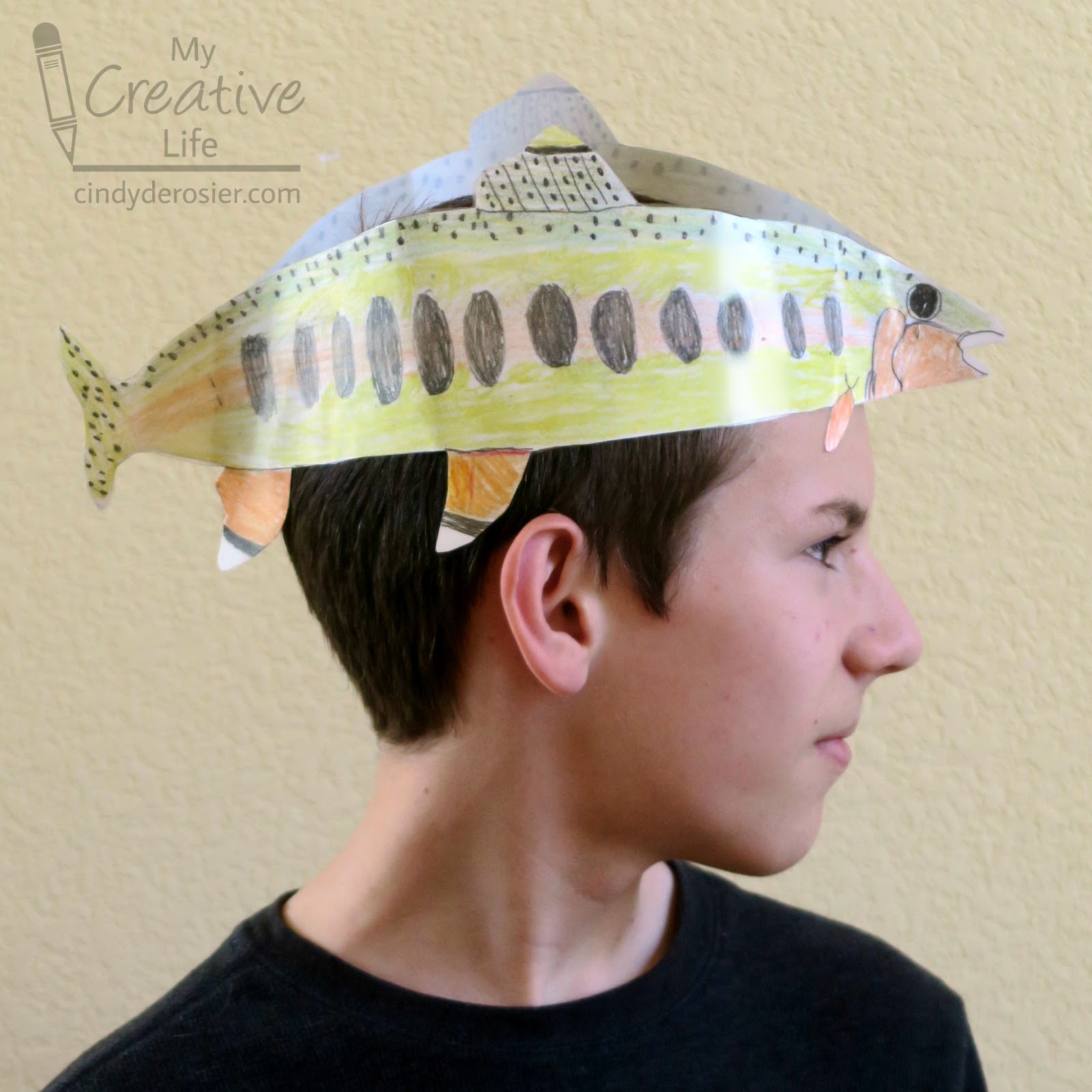
Here's a sample done by one of my students, Catherine S., back in the day (modeled by Trevor, the most cooperative 13-year old boy of all time). 


It is California's state fish, the golden trout. 


---------

I checked out "fish hat" on Amazon to see what was out there and it did not disappoint. This light-up angler fish hat is awesome. I like the shine on these 'luau fish' hats, but I'm trying to understand why they only come in packs of six. And speaking of trying to understand, I don't understand this fish hat at all. It is just plain creepy.